Declare War on Textbooks Now!
Well, not exactly…
One of the qualifying features of education today is textbooks. Varying in many sizes and lengths (and weights), students everywhere fight to figure out how to somehow keep them all in their locker or in their book bag or in another helpful (although unorthodox) spot. An attempt to rectify this in the present day is the introduction of electronic textbooks or eTextbooks. While eTextbooks certainly solve the issue of textbook-induced scoliosis, this still does not address the larger issue at hand. We place a premium on textbooks, and in a way we should. Take your average high school level Global studies class. Now those are some big textbooks! Textbooks can give students a synopsis of the overall content and give teachers a framework for what they need to cover for the year. In this sense, textbooks are incredibly useful. However, they can leave much to be desired.
Textbooks are filled with information, but from where is this information obtained? How is it that we know that Julius Caesar did this or Abraham Lincoln said that? Everyone who knew them is dead! This unique predicament gives us the opportunity to go to the gold mine of History, the buried treasure, the Lake Victoria to our Nile River of studies—primary sources.
In my own Global Studies and United States History classes, I made a point to flood each class with as many primary sources as possible. In order to do this, I would examine the overall unit, such as the unit we completed this past Fall about the early American Republic, and make a list of all the major primary source texts I could think of. I decided to pick some of the more intimidating ones, like the Articles of Confederation and the Northwest Ordinance of 1787.
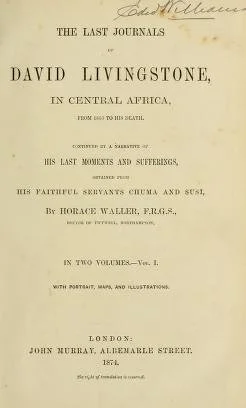
Primary Text: Last Journals of David Livingstone
Primary sources serve the purpose of helping us gather insight into the particular daily lives and minds of individuals from these past times. For example, when reading James Madison’s Notes on the Debates in the Federal Convention, we come to see that the Founding Fathers did have a genuine interest in doing away with the institution of slavery. Or when we read David Livingstone’s Field Diaries, we see his experience of pre-colonial Africa, full of deadly diseases, violence, and superstition. While the backwardness of these places did not justify any evils which were committed against the peoples of the continent, it is no surprise that Europeans took such a stance. After all, their civilized Christian culture built large Churches, Universities, and circumnavigated the world whereas these simple tribes apparently thought nothing of development, improvement, or progress and seemingly settled for squalor and superstition.
“But John,” you interject. “Won’t that be difficult for Juniors in High School?” Yes, it can be and in many cases will be. But that’s the point! By utilizing primary sources, students are forced to wrestle with texts of varying difficulties and degrees of language. This helps to develop their skills with using context clues to understand the text. This also helps them to wrestle with direct sources and think critically about what they are reading. You don’t get stronger by lifting weights that are lightweight and easy. Students will never become better at reading and writing if they don’t encounter difficult reading and writing. In our post-Pandemic world as educators, one of the things we have noticed the most is the disconnect of literacy amongst students due to interruptions caused by COVID.
“Okay, John,” you say. “You’ve convinced me to use more primary sources. How exactly do you implement that pedagogically?” To build off of what I already mentioned above, I would intentionally select at least three primary sources for a unit. Along with texts, I also use images, like paintings or photographs. We often can forget that artistic expression is also a language! Other sources will simply be excerpts that are focused on a specific concept. In each unit will be a larger text, which will be used for seminar style discussions with the students. This gives them the opportunity to not only wrestle with their own thoughts but the thoughts of their peers. Large excerpts from works like The Communist Manifesto or a papal encyclical like Rerum Novarum are perfect examples of these sources. I think of them as pieces of a puzzle, which form a beautiful picture when it is finally assembled. The best part of these puzzles is finding relatively unknown primary sources. How could I illustrate to students what colonial life was like? I could tell them what the textbook says or what my professors and teachers told me in college and high school. Instead, I could use the technology of our day to scour the internet for digital copies of firsthand accounts of settlers from Plymouth or Jamestown or any other early colony. You would not believe how many are out there, waiting patiently for the next teacher to find them and to tell their story.
The results have been great. There is a greater overall participation in class from the students when dealing with these sources and there is an opportunity to go beneath the surface. History is not about dates and places and events. It’s about understanding relationships like cause and effect. Nothing happens in a vacuum. Everything has a purpose! Primary sources are like time machines. When you read them, you cross a threshold into a different time and encounter the great mysticism of bygone eras. This can inspire the student to explore for themselves a new world, filled with lessons and morals which can be applied to the present day. It is for this reason that we study History—to learn where we have come from so we may know where we are going.